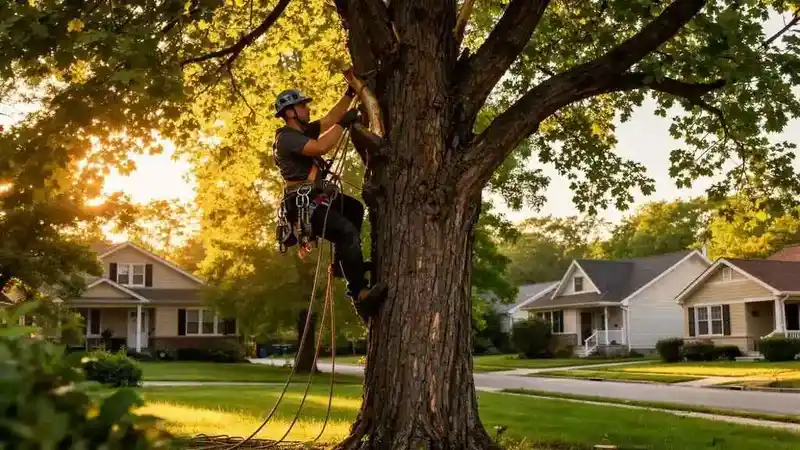
Trees add beauty, shade, and value to your Colorado Springs property. But a damaged, diseased, or dying tree can become a serious safety hazard — one that could damage your home, your car, or injure someone.
Here are the seven warning signs that a tree on your property may need to be removed.
1. The Tree Is Leaning Suddenly
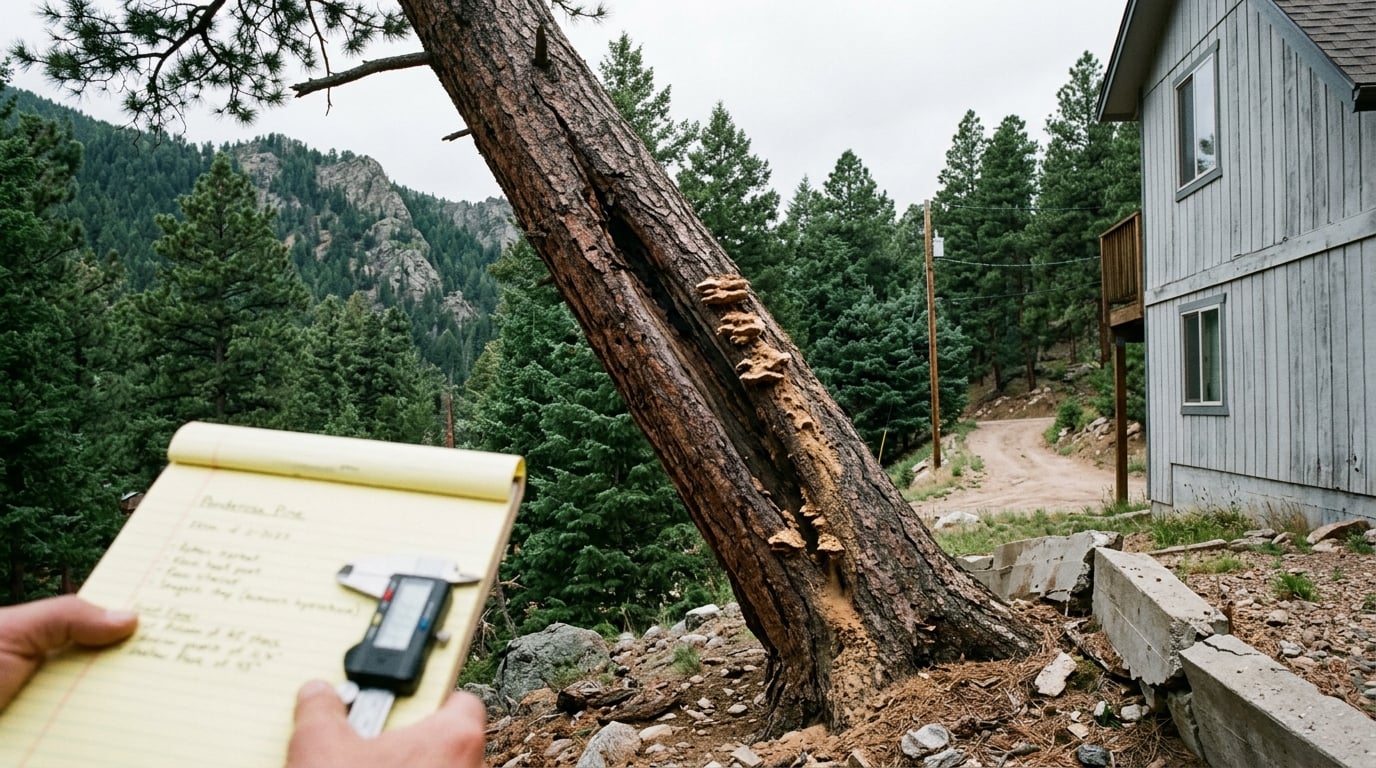
All trees lean a little — that's normal. What's NOT normal is a sudden change in lean, especially after a storm. If a tree that's been straight for years is suddenly leaning 15 degrees or more, it may indicate root failure. Look for:
- Cracked or heaving soil on the opposite side of the lean
- Exposed roots on the leaning side
- The lean getting worse over days or weeks
This is an emergency. A tree with root failure can fall without warning. Call an arborist immediately.
2. Large Dead Branches in the Crown
Dead branches — sometimes called "widow makers" in the tree industry — are one of the most common hazards. They can fall at any time, in any weather, without warning.
Signs of dead branches include:
- No leaves during the growing season (on deciduous trees)
- Bark falling off, revealing bare wood
- Brittle branches that snap easily
- Brown or orange needles on evergreens
A few dead branches can often be pruned out. But if more than 50% of the crown is dead, the tree is likely in decline and removal may be the safest option.
3. Fungal Growth at the Base
Mushrooms growing at the base of a tree or on the trunk are a red flag. They indicate internal decay — the fungi are feeding on rotting wood inside the tree. Common culprits in Colorado include:
- Armillaria (honey fungus) — clusters of honey-colored mushrooms at the base
- Artist's conk — hard, shelf-like growths on the trunk
- Ganoderma — reddish-brown brackets near the root flare
A tree with significant internal decay can look perfectly healthy from the outside but be completely hollow inside. It can snap at the trunk in a moderate wind.
4. Trunk Cracks or Cavities
Deep cracks in the trunk, especially vertical splits, indicate structural weakness. The trunk is the tree's main support — if it's compromised, the tree is at risk of failure.
Look for:
- Vertical cracks or splits that go deep into the wood
- Cavities or holes where branches once were (sign of internal decay)
- Bark that's separating from the trunk
- Seams where the trunk splits into two co-dominant stems ("V" crotch)
Co-dominant stems with included bark (where bark grows into the "V" instead of wood) are especially dangerous. They can split apart under snow load or wind — we see this frequently in Colorado Springs after our spring blizzards.
5. Root Damage or Soil Changes
Roots anchor the tree and absorb water. When they're damaged, the tree loses stability and health. Watch for:
- Construction damage — If you've had trenching, grading, or paving done within the tree's drip line, roots may be severed. Symptoms can take 2–5 years to appear.
- Root rot — Soft, mushy roots or mushrooms growing in a ring around the base
- Soil heaving — The ground lifting on one side of the tree, indicating roots are pulling out
- Compacted soil — Heavy equipment or constant foot traffic can suffocate roots
6. The Tree Is Too Close to Your Home
Sometimes a perfectly healthy tree is simply in the wrong place. Trees planted too close to structures can cause problems over time:
- Branches scraping the roof or siding (entry point for moisture and pests)
- Roots invading foundation, sewer lines, or underground utilities
- Canopy blocking all sunlight, promoting moss and moisture damage
- Fire risk — trees touching your house eliminate your defensible space
As a rule of thumb, large trees should be at least 20 feet from your house and well away from power lines. In fire-prone areas like Black Forest, the recommendation increases to 30+ feet.
7. The Tree Has Been Topped
"Topping" — cutting all the main branches back to stubs — is one of the worst things you can do to a tree. Unfortunately, it's been done to many trees in Colorado Springs over the years.
Topped trees develop weak, fast-growing "water sprouts" from each cut. These sprouts are poorly attached and prone to breaking. A topped tree often becomes MORE dangerous than it was before, not less.
If your tree was topped years ago and now has a cluster of spindly branches growing from each stub, it may be structurally compromised beyond repair.
What to Do If You See These Signs
Don't panic — and don't try to assess a dangerous tree yourself. A trained arborist can evaluate the tree's condition and give you an honest recommendation. Sometimes cabling, bracing, or targeted pruning can save a tree that looks bad. Other times, removal really is the safest option.
The one thing you should never do is ignore the problem. A tree that fails in a storm can cause tens of thousands of dollars in damage — or worse.
Concerned about a tree on your property? Call us at (719) 481-2500 for a free assessment, or request a quote online. Our ISA Certified Arborists will give you a straight answer.
Need Professional Tree Care?
Our ISA Certified Arborists have been serving Colorado Springs since 1976. Free estimates, honest advice.